Grants explainer
What is the Boiler Upgrade Scheme? A Homeowner's Plain-English Guide
The £7,500 BUS grant explained without jargon. Who qualifies, how to apply, what to expect, and the four reasons applications get rejected.
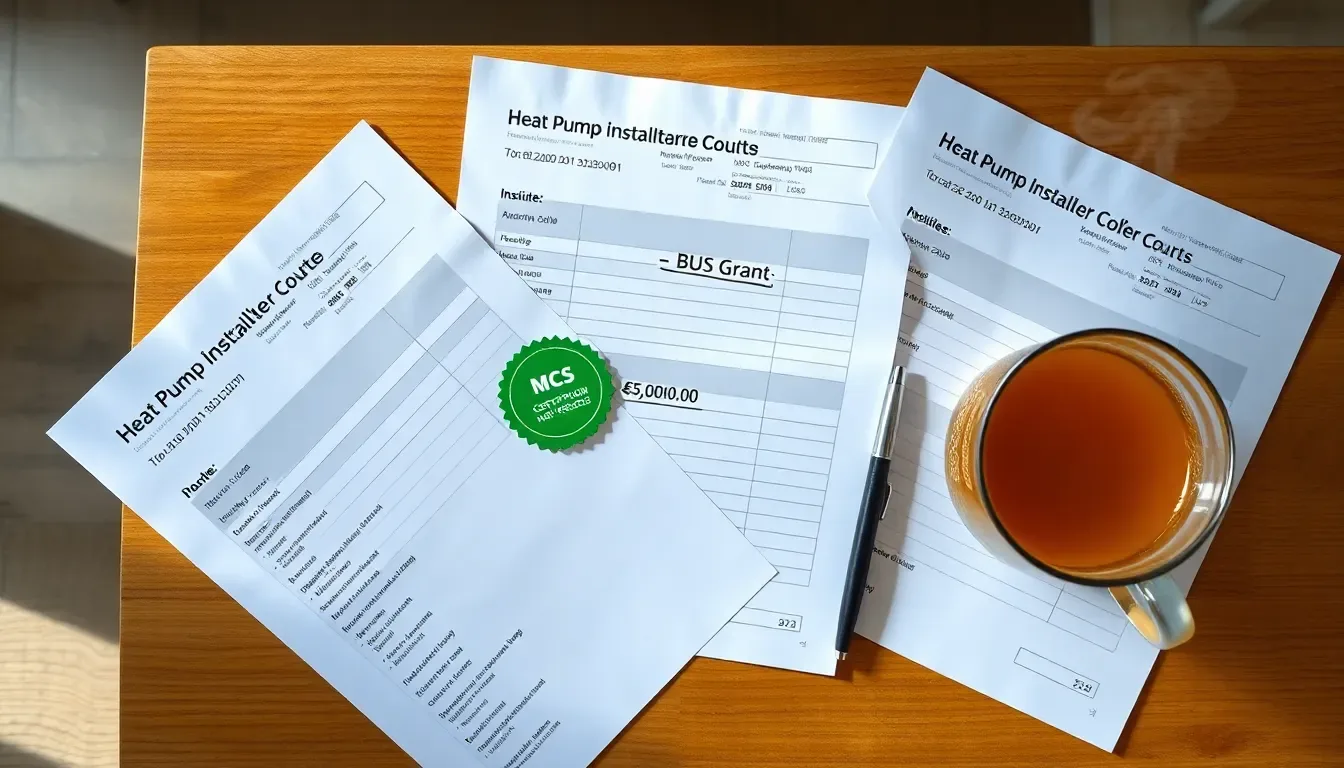
The Boiler Upgrade Scheme is the UK government’s main heat pump grant. £7,500, available to English and Welsh homeowners, paid as a deduction from your installer’s invoice. It runs until 31 December 2027 and is the single most important policy lever for heat pump uptake in the UK today.
This is a plain-English walkthrough — what BUS actually does, who qualifies, how to apply, and what gets people rejected.
What BUS is (and isn’t)
BUS is a grant, not a loan, not a tax credit, not a rebate. It pays directly to your installer to reduce the price you pay. You don’t fill in a tax form, you don’t wait for a cheque, you don’t pay upfront and reclaim. The amount comes off your final invoice.
It’s administered by Ofgem (the energy regulator) on behalf of DESNZ (Department for Energy Security and Net Zero). It applies in England and Wales only — Scotland has Home Energy Scotland; Northern Ireland has its own arrangements.
The grant is £7,500 for both air source and ground source heat pumps. It’s £5,000 for biomass boilers, but only in narrow off-grid rural circumstances.
It applies once per property, ever. You can’t claim it twice on the same property even if you sell and the new owner wants a different system.
Who qualifies — the six rules
- Property is in England or Wales. Not Scotland (HES), not Northern Ireland.
- Owner-occupied or privately rented. Tenants can’t apply directly; landlords can.
- EPC of D or above. OR you have valid loft and cavity wall insulation already (or are exempt from needing them).
- Replacing fossil-fuel heating. Gas, oil, LPG. Electric heating qualifies in many cases. Biomass may qualify with caveats.
- Property hasn’t had BUS before. Once-per-property limit.
- MCS-certified installer. Only certified installers can submit applications via the Ofgem portal.
Pass all six, you’re eligible. Fail one, you’re not — though most fails are correctable.
How to apply — the nine-step process
- Choose three MCS-certified installers. Use our installer finder or the public MCS register at mcscertified.com.
- Get them to survey your home. Each does a heat loss calculation, audits radiators and pipework, proposes a system size.
- Compare quotes. Each should show net cost (after grant) clearly. Watch for installers who hide the breakdown.
- Pick one. Sign their “redemption statement” — this is what authorises them to claim the grant on your behalf.
- Installer applies via the Ofgem portal. Submission includes your property details, the system proposed, and your signed authorisation.
- Ofgem decides — typically 2–4 weeks. Most applications are approved.
- Voucher issued. Valid for 3 months (heat pump) or 6 months (biomass). Install must complete within that window.
- Installation happens. Typically 2–5 days on site for ASHP, longer for ground source.
- Installer claims grant back from Ofgem after commissioning. You pay the net invoice (gross minus £7,500).
You never personally interact with Ofgem. You never fill in a government form. The installer does the heavy lifting.
The four most common rejection reasons
1. EPC rated E, F or G. Most common rejection. Fix: install the recommended insulation (often funded for free under ECO4 if you qualify). Re-EPC. Re-apply.
2. Property has already had a BUS grant. Sometimes you buy a home and find out the previous owner used BUS. Hard to detect ahead of time — your installer can check during application. Not fixable.
3. Installer lapsed MCS certification. Their certificate expired or was suspended between you signing and them applying. Fix: switch installer. Always verify MCS status on the public register before signing anything.
4. New-build property (under 24 months old). BUS is for retrofit. New builds are funded through other routes. Not BUS-eligible.
What BUS doesn’t cover
BUS pays for the heat pump system and its installation. It doesn’t pay for:
- Insulation upgrades needed to qualify
- Hot water cylinders if you’re switching from a combi (this is now usually included in install scope by installers, but check)
- Major radiator upgrades (these are part of the install cost, but the £7,500 doesn’t increase for them)
- Solar panels or battery storage (separate routes)
- Smart thermostats (often included in install scope)
- Repairs to existing pipework or electrical work needed to support the install
For most homeowners, the gross install cost (£10,500–£14,500 for an ASHP) includes everything; the £7,500 BUS grant covers the heat pump portion specifically.
Combining BUS with other grants
You can’t get two grants for the same install. But you can sequence grants:
- ECO4 → BUS. ECO4 (means-tested) can fund the insulation upgrades you need to become BUS-eligible. Then you apply for BUS separately for the heat pump.
- Welsh Nest → BUS. Same principle in Wales.
- Council retrofit schemes → BUS. Some local authorities have stackable schemes for insulation that don’t disqualify you from BUS.
What you can’t do:
- BUS + Home Energy Scotland (mutually exclusive — choose by geography)
- BUS twice on the same property
- BUS for a hybrid system (only full heat pump systems qualify)
Will BUS be extended past 2027?
Honestly, nobody knows. The current end date is 31 December 2027, firm. The government has signalled support for continued heat pump deployment but hasn’t announced any extension.
Three scenarios:
- Extension under similar terms — possible. Industry has lobbied hard. Treasury is supportive but budget-constrained.
- Replacement scheme — possible. Could be different (e.g. graduated based on EPC improvement).
- No successor — unlikely given UK net-zero commitments, but possible.
Plan as if BUS will close. If it extends, that’s a bonus. Don’t bet your timeline on extension.
What if I want to install in 2027?
December 2027 is when the scheme closes — meaning no new applications are accepted past that date. Crucially, your installation just needs to start (technically, the voucher needs to have been issued) before then. The actual install can happen in early 2028.
In practice:
- Apply by mid-2027 to be safe
- Allow 8–14 weeks lead time from quote to commissioning
- The closer to the deadline, the more pressure on installer schedules — book early
The bottom line
BUS is the most straightforward UK government grant for heat pumps. £7,500, owner-occupiers and landlords, England and Wales, runs to end of 2027. Your installer handles the paperwork. The grant comes off your invoice.
Use our eligibility checker to run all six rules against your property in 60 seconds. If you qualify, our installer finder shows MCS-certified installers in your area.